
- All
- Product Name
- Product Keyword
- Product Model
- Product Summary
- Product Description
- Multi Field Search
Views: 0 Author: Site Editor Publish Time: 2026-07-07 Origin: Site


The industrial shift toward environmentally compliant, silica-free abrasives has positioned recycled glass as a primary choice for surface preparation, but specifying the exact parameters remains a technical challenge. Selecting the incorrect abrasive media—or the wrong mesh size—results in substrate warping, insufficient anchor patterns for coating adhesion, excessive media consumption, and project delays. To achieve the required mil profile while controlling operational efficiency, facility managers and blasting contractors must evaluate crushed glass against specific success criteria, including substrate hardness, coating specifications, and equipment compatibility. Hitting the exact surface profile required by the coating manufacturer without damaging the underlying steel or aluminum requires a deep understanding of abrasive physical properties. Field operators need reliable data to calibrate their blast pots, select the right nozzle, and dial in the metering valve for optimal flow.
Profile Control: Crushed glass blasting media produces a sharp, angular anchor pattern ideal for high-build coatings, contrasting with the peening effect of spherical glass beads.
Health and Compliance: Utilizing 100% recycled, silica-free glass mitigates the respiratory risks associated with traditional sandblasting and simplifies environmental compliance.
Substrate Versatility: By adjusting mesh sizes (from coarse 10/20 to fine 70/100) and blast pressure, crushed glass can be calibrated for everything from heavy structural steel rust removal to delicate fiberglass restoration.
Cost Efficiency: While generally a single-use abrasive due to its friability, its lighter bulk density allows for more surface area coverage per pound compared to heavier mineral abrasives.
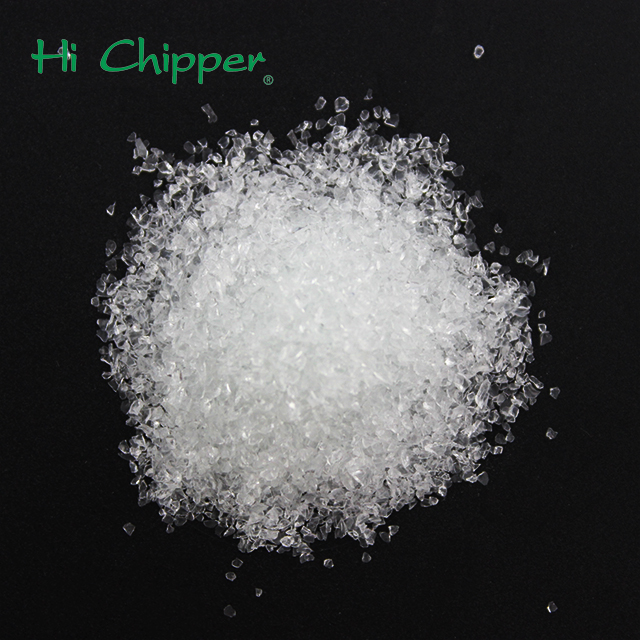
Recycled post-consumer glass forms the foundation of this abrasive. The manufacturing process crushes and screens the glass to create a highly angular particle shape. The material registers a Mohs hardness of 5.5 to 6.0. This specific angularity directly translates to aggressive cutting action. It slices through thick industrial epoxies and heavy rust rather than pounding the surface. This physical trait ensures efficient coating removal while leaving a clean, profiled surface ready for new applications. The sub-angular edges fracture upon impact, continuously exposing new sharp edges during the split second it hits the substrate. This dynamic fracturing is what gives glass its rapid cutting speed on structural steel and concrete.
When evaluating abrasives for field use, hardness dictates the energy transfer. A Mohs hardness of 5.5 to 6.0 places glass right in the sweet spot for general surface preparation. It is hard enough to strip mill scale and marine coatings, yet forgiving enough to prevent excessive metal removal on standard carbon steel. Operators running standard blast pots will notice that the angular profile digs into the rust matrix, lifting it from the surface rather than just polishing the top layer. This creates the microscopic peaks and valleys—the anchor pattern—that high-performance industrial coatings require for mechanical adhesion.
Utility-grade mixed-color glass works well for basic rust removal on heavy equipment or concrete scarification. However, premium Crushed Clear Glass offers distinct operational advantages for specialized applications. Clear glass prevents color contamination on sensitive substrates like aluminum, stainless steel, or architectural concrete. It provides superior surface visibility during the blasting process. Operators can clearly see the substrate condition as they work, reducing over-blasting and saving time. This clarity is essential for projects requiring a pristine, white-metal equivalent finish (SSPC-SP 5 or NACE No. 1).
Mixed-color glass often contains pigments and impurities that can leave a dark, dusty residue embedded in the newly created anchor profile. If you are applying a light-colored primer or a specialized clear coat, this residue can bleed through or compromise the chemical bond. Clear glass eliminates this variable. It leaves a bright, clean finish that makes visual inspection for flash rust or remaining contaminants much easier for quality control inspectors. When working inside tanks or poorly lit containment structures, the bright white dust of clear glass significantly improves operator visibility compared to the dark clouds generated by slags or mixed glass.
Regulatory compliance drives many surface preparation decisions on modern jobsites. Glass abrasives contain less than 1% free silica. This composition easily meets strict OSHA compliance standards for airborne particulates, specifically the respirable crystalline silica standard. While operators must still wear proper supplied-air respirators (Type CE), the surrounding jobsite and other trades working nearby face significantly lower respiratory risks compared to traditional sandblasting operations.
The media is chemically inert and non-toxic. It prevents heavy metal leaching during aquatic or environmentally sensitive projects. You can blast near waterways, overpasses, or in open environments without introducing hazardous heavy metals like beryllium or trace lead into the surrounding soil or water table. Environmental agencies heavily scrutinize abrasive blasting over open water. Using an inert glass abrasive simplifies the permitting process and reduces the containment requirements compared to using heavy metal-bearing slags. Post-blast cleanup is also safer, as the spent media itself does not classify as hazardous waste, provided the coating removed was not hazardous.
Operators often confuse crushed glass with glass beads, but they serve completely different functions in the field. Crushed glass features an angular shape that cuts into the substrate. This creates a surface profile necessary for coating adhesion. Glass beads are perfectly spherical. They peen the surface. You use beads in blast cabinets for cleaning, polishing, and stress relief without causing dimensional changes to the metal. If you try to prep a surface for a high-build epoxy using glass beads, the coating will fail due to a lack of mechanical tooth. Conversely, if you try to polish an engine block with crushed glass, you will ruin the machined tolerances.
Garnet is heavier and harder than glass, typically registering 7.5 to 8.0 on the Mohs scale. It cuts faster on heavy marine coatings but carries a higher risk of embedment in softer metals. Density and hardness dictate kinetic energy upon impact. Under identical blast pressures, 40/70 crushed glass blasting media delivers a more gentle impact than the exact same mesh size of garnet. This lower kinetic energy reduces the risk of substrate deformation on thin metal panels, such as automotive bodies or architectural cladding. Garnet is excellent for multi-pass recycling facilities, whereas glass is the go-to for open-air, single-use blasting where recovery is impossible.
Aluminum oxide is exceptionally hard, registering a 9.0 on the Mohs scale. Glass sits between 5.5 and 6.0. You use aluminum oxide for aggressive profiling on hardened steel or in dedicated blast rooms with heavy-duty reclamation systems. For precision applications like glass etching, monument detailing, or engineering art, ultra-fine glass provides excellent control without destroying the stencil. You switch to specialized 150-220 grit aluminum oxide only when you need delicate detailing that requires a harder cutting edge on materials like granite or hardened alloys. Aluminum oxide will chew through standard blast hoses and nozzles rapidly, whereas glass is much easier on your equipment consumables.
Coal slag presents significant environmental and health trade-offs. It often contains trace heavy metals and beryllium. Glass leaves a cleaner, whiter finish. It completely eliminates the dark residue and oily surface film associated with coal and copper slags. Glass provides a safer working environment and reduces post-blast cleanup requirements. When you blast with slag, the surface often requires a secondary wash or blow-down to remove the black dust before priming. Glass leaves a surface that is generally ready for immediate coating application once the loose dust is blown off with clean, dry air.
Abrasive Type |
Particle Shape |
Mohs Hardness |
Primary Field Application |
Resulting Surface Finish |
|---|---|---|---|---|
Crushed Glass |
Highly Angular |
5.5 - 6.0 |
Coating removal, profiling steel/aluminum |
Clean, bright, white-metal equivalent |
Glass Beads |
Spherical |
5.5 - 6.0 |
Peening, polishing, dimensional cleaning |
Smooth, bright, dimpled |
Garnet |
Sub-angular |
7.5 - 8.0 |
Aggressive cutting, thick marine epoxies |
Textured, dark, slight embedment risk |
Aluminum Oxide |
Highly Angular |
9.0 |
Deep profiling, hard alloy prep, etching |
Matte, highly textured, aggressive tooth |
Coal Slag |
Angular |
7.0 - 7.5 |
Heavy rust removal, bridge maintenance |
Dark residue, potential oily film |
Determine the yield strength of the target metal or composite first. Thin aluminum, automotive sheet metal, or aerospace composites warp easily under high pressure and heavy media impact. Establish maximum blast pressure limits before selecting your abrasive. Match the media hardness to the substrate to prevent irreversible damage. If you are working on a 20-gauge steel car hood, hitting it with coarse slag at 100 PSI will stretch the metal and ruin the panel. Switching to a fine crushed glass at 45-60 PSI provides the necessary cutting action to remove the paint without generating the heat and kinetic energy that causes oil-canning.
Select the abrasive grit size based strictly on the coating manufacturer’s specified mil profile. A profile that is too shallow causes coating failure and delamination. A profile that is too deep allows rust to form on exposed peaks (pinpoint rusting) because the primer cannot cover the high spots. Read the technical data sheet for your primer or topcoat. If the zinc-rich primer requires a 2.0 to 2.5 mil profile, you must select a medium mesh glass and verify the results on-site using replica tape and a spring micrometer before proceeding with the entire structure.
Use heavier, coarser grits for thick elastomeric coatings, multi-layer marine epoxies, or heavy coal-tar enamels. These thick coatings require aggressive cutting action and mass to break through the rubbery or hardened layers. Use finer grits for thin primers, light rust, or mill scale. Finer grits provide more impacts per square inch. Imagine throwing a handful of gravel versus a handful of sand; the sand hits more surface area simultaneously, stripping thin layers rapidly and efficiently without wasting energy digging too deep into the base metal.
Ensure your chosen media works with your specific equipment setup. Check compatibility with pressure pots, suction cabinets, or vapor-blasting systems. Some fine grits clump in high-humidity environments if your compressor lacks an adequate air dryer or moisture separator. Verify your metering valve (like a Schmidt valve) can handle the specific mesh size without clogging or surging. Coarse glass flows differently than fine glass, and failing to adjust the abrasive metering valve will result in a rich mixture that chokes the blast hose and wastes media.
Analyze your blast environment and containment capabilities. Crushed glass is a low-cost, single-use media. It shatters upon impact, turning largely to dust. Determine if this single-use approach is more economical than using a multi-pass media like garnet or aluminum oxide. Factor in the high setup costs required for media reclamation systems, vacuums, and classifiers. For open-air blasting on bridges, water towers, or shipyards where recovering the media is physically impossible or cost-prohibitive, a single-use glass abrasive is the only logical choice.
Factor in local dust emission constraints. Check municipal water-table protections and respiratory safety mandates. Silica-free glass helps you meet strict environmental regulations easily. It simplifies permitting for outdoor blasting projects near sensitive ecological zones, residential neighborhoods, or active industrial facilities. When working in urban environments, the inert nature of glass prevents toxic runoff into storm drains, keeping your operation compliant with local EPA or equivalent environmental agency guidelines.
Coarse grits tackle the most demanding surface preparation tasks in the industrial sector. You use these sizes for heavy rust, thick industrial epoxies, tank linings, and elastomeric coatings. They excel on structural steel, heavy machinery, and marine hulls. Expect deep anchor patterns ranging from a 3.0 to 4.5 mil profile, depending on your blast pressure and standoff distance. This deep profile is mandatory for high-build industrial coatings, metallizing, or thermal spray applications that require maximum mechanical adhesion to prevent catastrophic failure in corrosive environments.
When running coarse glass, operators need to maintain a proper standoff distance of 18 to 24 inches to allow the large particles to achieve maximum velocity before impact. Using a #7 or #8 nozzle requires a massive air compressor (300 to 400 CFM) to maintain 100+ PSI at the nozzle. The large particles carry significant mass, meaning they hit hard and fracture violently. This makes coarse glass incredibly effective at shattering brittle coatings like old coal tar or thick alkyd enamels that would otherwise gum up finer abrasives.
Medium grits serve as the industry standard for general maintenance and fabrication shops. They effectively remove mill scale, light to medium rust, and old paint from carbon steel. You see them used frequently in automotive restoration, fleet maintenance, trailer refurbishment, and structural steel fabrication. These sizes generate moderate anchor patterns between 1.5 and 2.5 mils. This profile perfectly suits standard primers, polyurethanes, basic industrial enamels, and powder coating applications.
The 40/70 mesh size offers the best balance of cutting speed and surface finish. It provides enough mass to break through standard coatings while delivering a high particle count for rapid surface coverage. Operators find that medium glass flows exceptionally well through standard metering valves without the surging issues sometimes associated with very coarse or very fine media. It leaves a clean, uniform finish that requires minimal secondary prep before moving the steel into the paint booth.
Fine grits protect vulnerable surfaces from damage while still providing a mechanical tooth. Use them on aluminum, brass, wood restoration, fiberglass, and thin sheet metal. They also work well for glass etching, graffiti removal on masonry, and log cabin restoration. Expect minimal substrate removal and light profiling between 0.5 and 1.0 mils. Fine grits prevent surface warping on thin panels while leaving a smooth, clean finish that is ready for light primers or clear coats.
When blasting fiberglass boat hulls to remove anti-fouling paint, fine glass removes the paint without tearing into the delicate gel coat. On architectural wood or masonry, fine glass operates more like a heavy sanding process, stripping away dirt, char, or graffiti without destroying the natural grain or brick face. Operators must dial down the blast pressure—often operating between 40 and 60 PSI—to maximize the effectiveness of fine glass and prevent substrate damage.
Crushed glass performs exceptionally well in both traditional dry blasting pots and modern vapor or dustless blasting systems. In dustless blasting setups, water encapsulation drastically reduces airborne particulates, keeping the jobsite clean and improving visibility. The water adds mass to the particle, slightly altering the impact force and creating a hydro-static washing effect that removes soluble salts from the steel simultaneously. This is a massive advantage when prepping steel in coastal environments where chloride contamination causes premature coating failure.
You must manage flowability carefully in wet systems. Keep the media dry before it enters the slurry pot or the water injection ring to prevent clumping. If moisture backs up into a traditional dry pot, the glass will bridge over the metering valve, halting production immediately. Operators must ensure their air compressors are equipped with high-quality aftercoolers and moisture separators to deliver clean, dry air to the blast pot, especially when running fine mesh glass in humid climates.
Media hardness directly impacts equipment consumables. Glass is significantly less abrasive on nozzles, blast hoses, and metering valves than aluminum oxide or silicon carbide. You will replace consumables less frequently, keeping your rig running longer between maintenance intervals. A standard tungsten carbide nozzle will last hundreds of hours shooting glass, whereas it might wear out in a fraction of that time shooting harder abrasives.
Always optimize your blast pressure at the nozzle, not just at the compressor gauge. Use a hypodermic needle gauge to check the actual pressure right behind the nozzle. Lower your PSI for thin automotive panels to prevent warping. Increase PSI only when tackling thick steel or heavy marine epoxies. Remember that increasing pressure increases media breakdown; pushing glass at 120 PSI will cause it to shatter into finer dust upon impact, which might reduce your effective mil profile compared to shooting it at 90 PSI.
Friability defines how an abrasive breaks down under pressure. Glass shatters upon impact. This shattering effect transfers energy efficiently to the coating, stripping it rapidly. However, this high friability makes glass unsuitable for closed-loop reclamation systems or blast cabinets where media is recycled dozens of times. After one pass against hard steel, the glass particles turn to dust and lose their cutting edges.
You trade the inability to recycle the media for a much lower initial cost per ton and the convenience of not having to sweep, screen, and reload the abrasive. Plan your inventory knowing this is a single-use consumable. Field operators must calculate their consumption rates accurately—typically ranging from 3 to 5 pounds of glass per square foot of steel, depending on the coating thickness and the operator's skill level. Proper adjustment of the abrasive metering valve is critical; running the mixture too rich wastes media without increasing cutting speed.
Review the technical data sheet of your specified coating to identify the exact required mil profile before selecting your abrasive mesh size.
Assess the yield strength and thickness of your substrate to establish safe maximum blasting pressures and prevent warping.
Calibrate your abrasive metering valve to ensure a lean, efficient flow of media, maximizing cutting speed while minimizing waste.
Install proper moisture separators and aftercoolers on your compressor to prevent fine glass from clumping in the blast pot.
Request a media sample to perform a small test patch and verify the anchor profile with replica tape before committing to bulk orders.
A: Crushed glass features an angular shape designed for cutting and profiling surfaces to ensure coating adhesion. Glass beads have a spherical shape used for peening, cleaning, and polishing without altering the dimensional integrity of the substrate.
A: No. It is manufactured entirely from recycled bottle or plate glass. It contains less than 1% free silica, making it fully OSHA compliant and safe for operators when standard respiratory protocols are followed.
A: Generally, no. It is highly friable, meaning it shatters into dust upon impact with the substrate. This makes it a highly effective single-use consumable rather than a recyclable media for blast cabinets.
A: Clear glass completely eliminates color pigments. Mixed-color glass can leave dark, difficult-to-see dust residues on light-colored substrates. Clear glass prevents this contamination, ensuring a pristine finish for specialized coatings.
A: The resulting profile depends heavily on blast pressure and substrate hardness. However, on standard carbon steel at typical blasting pressures, 40/70 mesh typically leaves a consistent 1.5 to 2.5 mil anchor pattern.
A: Yes, provided you use the correct parameters. You must use a fine mesh size, such as 70/100, and lower your blast pressure significantly. This combination cleans the aluminum without causing surface warping or excessive metal removal.
